








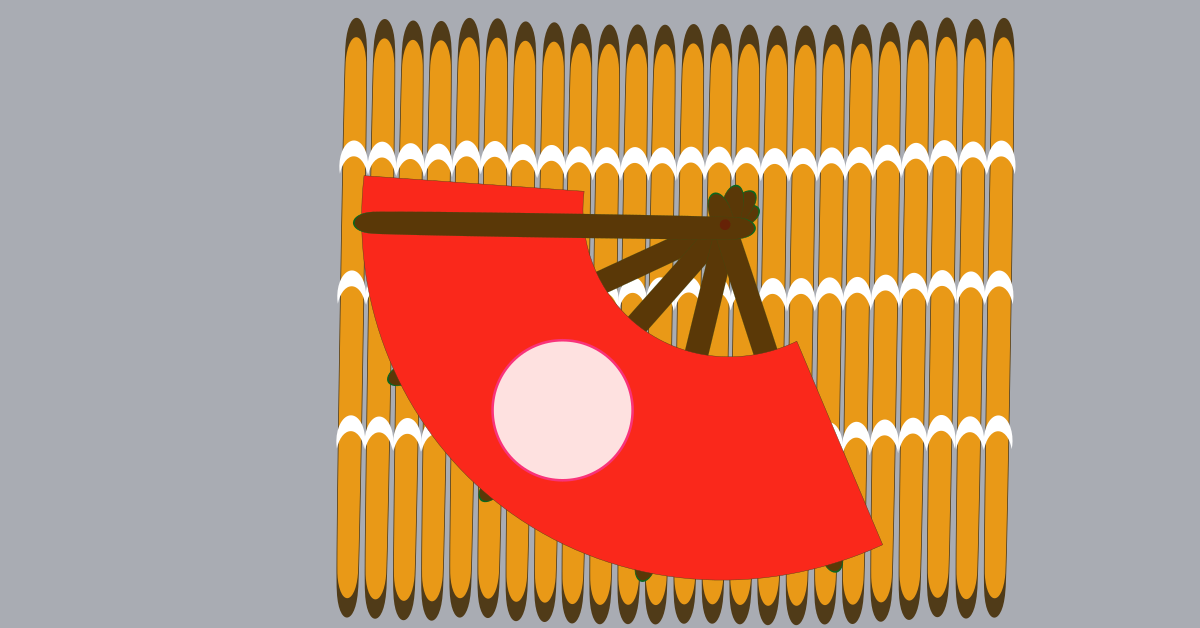
Sensu (扇子) and makisu (makisudare: 巻き簾) look completely different at first glance, but they have surprising similarities.
Sensu and Makisu
First of all, both are mainly made of bamboo. Bamboo is strong and elastic, making it suitable for making sensu and makisu.
They are similar in that they are made of long, thin bamboo poles connected together.
Both can be folded by opening and closing, although the methods are different. Sensu is fan-shaped when opened, but it becomes a small rod-like shape when closed by sliding it sideways. On the other hand, makisu is square when opened, but becomes cylindrical when rolled up. They are small and easy to carry around.
Both are functional, beautiful, and unique to Japanese culture. Both are traditional Japanese crafts that require the exceptional skills of craftsmen.
The ancestors of Sensu and Makisu are alike
It’s known that mokkan (wooden tablets) played a major role in the development of sensu.
Mokkan, which are wooden tablets on which characters are written, are long, thin boards of wood or bamboo. Satsu (冊) is mokkan lined up and bound together with strings. It’s equivalent to a modern-day book, but wood or bamboo was used instead of paper at the time. Satsu (冊) is structured like makisu.
The archetype for early sensu was made by stacking mokkan, punching holes in the ends, and binding them together with a paper string.
Satsu (冊) of mokkan could be carried around like a scroll.
Though they have a different shape now, the mokkan that formed the basis of sensu were very similar in form to makisu.
What is Sensu? The foldable fan originating in Japan

How to make Sensu: What’s the difference between Kyoto and Tokyo?

Roots of Sensu: Twists added at the Kyoto Imperial Court
What is Makisu? The rolling utensil that spread with sushi
Author: Takuya Nagata. Amazon Profile
Follow @nagatackleA novel writer and creator. Graduated from UCA, the UK’s university. Discussed Japanese minimalism in the senior thesis. Founder of “MINIRISM” (minirism), the art movement that contributes to the development of societies, such as ecology and lifestyle. Later opened the knowledge hub “The Minimalist.”
Once travelled to Brazil and trained football at CFZ do Rio (Centro de Futebol Zico Sociedade Esportiva) in Rio de Janeiro. Played soccer for the Urawa Reds (Urawa Red Diamonds), one of the biggest football clubs in Japan, and toured Europe. Retired at a young age and voyaged alone to England. Established careers as a journalist, football coach, consultant, etc. across Europe such as Spain. The founder of “Propulsive Football” (PROBALL), the world’s first-ever competitive mixed football, facilitating diversity and spirit for equal participation in society.
Knowledgeable in creative and technology fields as well. Launched the SPACE Culture & Entertainment hub “The Space-Timer 0.”
https://www.amazon.co.uk/Takuya-Nagata/e/B09LM3Z89P
https://x.com/nagatackle
https://www.instagram.com/nagatackle
https://www.facebook.com/takuya.nagata.794
https://www.linkedin.com/in/takuya-nagata-5730b069